
If unwanted light reaches your bed at night-or daylight fills the room when you need to sleep during the day-the most effective approach is to find where the light is entering and block that source first. Start with windows and curtain gaps, then deal with light under the door, glowing electronics, and any indoor lighting that remains visible from bed.
You do not need to turn the bedroom into a sealed cave or buy every product labeled blackout. The goal is a room that is dark enough for comfortable sleep while remaining safe to move through if you wake during the night. U.S. sleep guidance consistently recommends a dark bedroom, and CDC/NIOSH guidance specifically suggests opaque window coverings, blocking edge gaps, reducing white or blue light sources, and using an eye mask when environmental light cannot be fully controlled.
1. First, Find Out Where the Light Is Coming From
Do this after dark-or during the daytime if you sleep after a night shift. Turn off the bedroom lights, lie down where you normally sleep, and give your eyes a minute to adjust. The brightest source may not be the one you expected.
- Light leaking around the top, sides, or bottom of curtains or blinds.
- Streetlights, porch lights, signs, or headlights reaching the window.
- Hallway or bathroom light entering under or around the bedroom door.
- Alarm clocks, chargers, power strips, televisions, routers, and other indicator LEDs.
- A phone or tablet screen that lights up with notifications.
- Early morning sunlight reaching your face even when the rest of the room seems fairly dark.
- Fix the strongest source first. This is usually more effective-and cheaper-than adding several small darkness products at once.
2. Fix Window Light Before Anything Else
For many bedrooms, the window is the dominant source of unwanted light. Blinds can provide privacy while still allowing significant light through the slats and around the perimeter. CDC/NIOSH guidance for shift workers specifically recommends room-darkening shades or heavy lined draperies and notes that adjustments may be needed around the edges.
2.1 Check the curtain width and height
A curtain can use blackout fabric and still perform poorly if it barely covers the window. Look at the installation rather than the product label. Panels that extend beyond the window frame on both sides and above it generally have a better chance of intercepting light that would otherwise spill around the edges.
If light comes over the top, mounting the rod higher may help. If it enters from the sides, a wider rod, wider panels, or a wraparound-style rod may reduce the gap. If light appears below the curtain, longer panels or a separate window treatment behind the curtain may be more practical.
2.2 Layer window treatments when one layer is not enough
A blind or shade and a curtain do different jobs. Layering an opaque shade close to the glass with curtains farther into the room can address both direct light and edge leakage. This can be particularly useful when the window faces a streetlight or when you sleep during daylight hours.
Before replacing existing curtains, test the idea cheaply: temporarily block the visible gap and see whether the room becomes meaningfully darker. If it does, the problem may be fit rather than fabric.
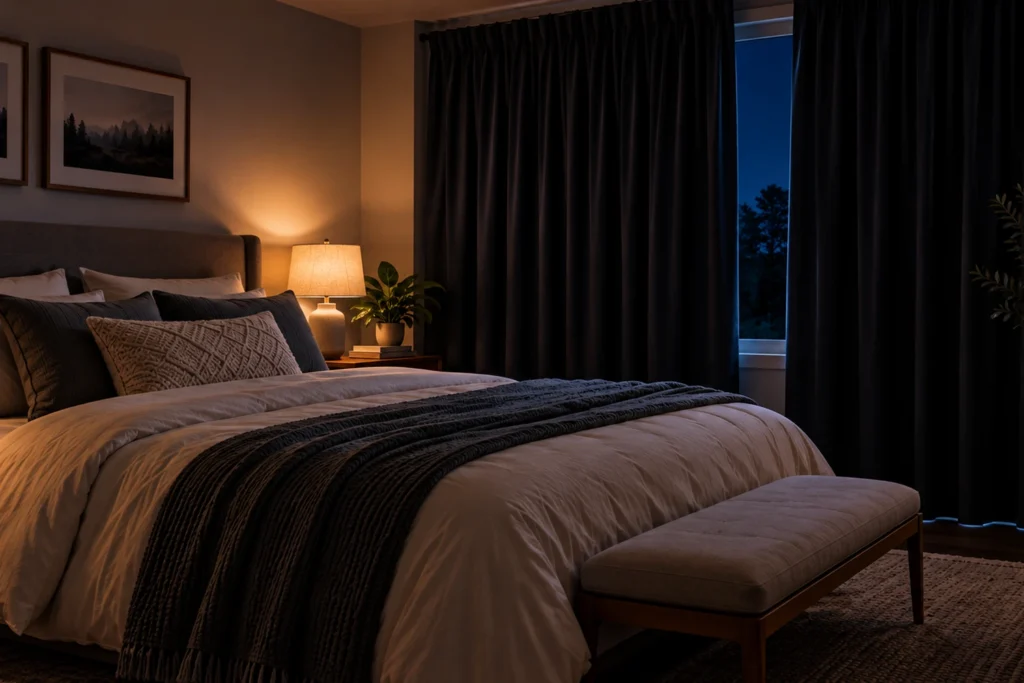
Heavy, well-fitted curtains can reduce window light, but the edges and center opening often deserve as much attention as the fabric.
3. Block the Gaps Around Blackout Curtains
The phrase blackout curtain can create the impression that buying the right fabric solves the entire problem. In practice, a narrow beam of light beside a curtain can remain obvious in an otherwise dark room.
Common fixes include using a wraparound curtain rod, allowing panels to overlap in the center, using side returns, or pairing curtains with a shade mounted closer to the window. Removable hook-and-loop strips or magnetic solutions may help in some setups, but make sure any adhesive is appropriate for the wall or frame surface.
If you rent, prioritize reversible changes. A tension rod, removable blackout panel, temporary shade, or carefully installed curtain system may be preferable to drilling multiple holes or applying materials that can damage paint.
4. Deal With Light Coming Under the Door
A bright hallway can turn a small door gap into a noticeable strip of light. The simplest solution is often to turn off or dim the hall light once everyone is settled. If the light must remain on, a door draft stopper or similar removable barrier can reduce the spill.
Be careful not to create a tripping hazard. If you regularly get up during the night, keep the route from the bed to the door and bathroom clear. CDC/NIOSH guidance notes that a dim red nightlight can be used when some light is needed for safe movement.
5. Remove Small Lights You Stop Noticing During the Day
Once the window is under control, small indoor light sources become easier to see. Walk around the room in darkness and look for indicator lights on chargers, televisions, speakers, air purifiers, clocks, routers, power strips, and other electronics.
If a light serves no useful nighttime purpose, turn the device off, move it, rotate it away from the bed, or cover the indicator in a way that does not block ventilation or safety warnings. A bright clock face can also encourage repeated time-checking, so positioning it out of direct view can solve two problems at once.
For phones, use Do Not Disturb settings and disable unnecessary lock-screen wakeups. NHLBI recommends avoiding bright artificial light before bed, and CDC recommends turning off electronic devices before bedtime. Darkness works best as part of the transition to sleep, not only after your eyes close.
6. Use an Eye Mask When You Cannot Control the Room
An eye mask can be a simple alternative when you cannot modify the window, share a room with someone who needs light, stay in hotels frequently, or need daytime sleep in changing locations. CDC/NIOSH specifically identifies an eye mask as an option when light is difficult to avoid.
Comfort matters more than marketing language. The mask should remain in place without pressing uncomfortably on the eyes or feeling overly tight. If you tend to remove it during sleep, changing the fit or material may be more useful than buying a more elaborate version.
An eye mask also does not solve every situation. If the entire room is brightly lit, you may still notice light when the mask shifts or when you wake. Combining a mask with basic room-darkening measures can be more reliable.
7. Make a Bedroom Darker for Daytime Sleep
Night-shift workers face a harder problem because daylight is much brighter than typical nighttime outdoor light. NHLBI recommends removing sound and light distractions during daytime sleep, including light-blocking curtains, while CDC/NIOSH advises making the room very dark and blocking light from windows and doorways.
For daytime sleep, inspect the room in full daylight rather than assuming curtains that look dark at night will perform the same way. Pay special attention to the curtain perimeter and any second window in an adjoining bathroom or hallway:
- Use an opaque shade or blackout layer close to the window.
- Add curtains that extend beyond the window opening to reduce side leakage.
- Reduce light from the bedroom door and adjacent spaces.
- Use an eye mask as a backup when full room control is impractical.
- Ask household members to keep bright lights and interruptions away from the sleep area when possible.
Do not make the trip home from a night shift less safe simply to reduce light exposure. If you are significantly sleepy, driving safety takes priority.
Look at the complete window setup: curtain coverage, side gaps, the center opening, and light that can enter above or below the treatment.

8. Keep Enough Light for Safety
A darker bedroom should not make nighttime movement unsafe. If you frequently get up to use the bathroom, keep the floor clear and avoid placing bags, cords, shoes, or furniture in the walking path.
If you need orientation light, use the lowest practical amount rather than switching on a bright overhead fixture. CDC/NIOSH notes a dim red nightlight as an option for the route to the bathroom. The point is to balance darkness for sleep with enough visibility to move safely.
9. What to Try Before Buying Blackout Curtains
If you are unsure whether darkness is really your problem, run a simple experiment for several nights. Temporarily cover the brightest gap safely, turn off unnecessary LEDs, and move your phone away from the bed. If the room feels noticeably better, you have useful evidence about where to invest.
- If the curtain fabric is already opaque but light leaks around it: improve fit or mounting first.
- If blinds glow across the whole window: consider an opaque shade or curtain layer.
- If only a streetlight beam reaches your pillow: reposition the bed, adjust the window covering, or use an eye mask.
- If morning sun is the problem: focus on the side or top gap where the sun enters rather than redesigning the whole room.
- If you sleep during the day: prioritize full-window coverage and edge control.
This problem-first approach helps avoid buying a product that addresses the wrong source of light.
10. A Quick Darkness Checklist
- Check the bedroom after your eyes have adjusted to darkness.
- Identify the brightest source visible from the pillow.
- Inspect the top, sides, center, and bottom of the window treatment.
- Turn off or reposition unnecessary electronic lights.
- Check the gap under the bedroom door.
- Use Do Not Disturb so the phone screen does not repeatedly light the room.
- Keep the path to the bathroom clear if the room is very dark.
- Test one change for several nights before buying the next solution.
11. When a Darker Bedroom Is Not the Whole Answer
A dark bedroom is one component of a supportive sleep environment, not a treatment for every sleep difficulty. If you continue to have persistent trouble falling asleep, staying asleep, or functioning during the day despite adequate opportunity for sleep, consider discussing the problem with a qualified healthcare professional.
Likewise, if darkness is already good, the next issue may be noise, temperature, physical comfort, or your sleep schedule. Avoid assuming that making the room progressively darker will solve a problem that is coming from somewhere else.
Read more: How to Create a Sleep-Friendly Bedroom: A Practical Guide
12. Frequently Asked Questions
12.1 How dark should a bedroom be for sleep?
Major U.S. sleep guidance recommends a dark bedroom rather than a specific measurable darkness level for every person. Practically, reduce light that is obvious or disruptive from your normal sleeping position while maintaining a safe route if you need to get up.
12.2 Are blackout curtains better than blinds?
It depends on the products and installation. Standard blinds often allow light through slats and edges, while well-fitted opaque curtains can block more light. A layered shade-and-curtain setup can work well when either treatment alone leaves gaps.
12.3 Why do my blackout curtains still let light in?
The fabric may be opaque while light enters around the top, sides, bottom, or center opening. Check fit before replacing the curtains. Wider panels, a higher or wraparound rod, overlap, or an additional shade may address the actual leak.
12.4 Can I darken a bedroom without drilling holes?
Yes. Depending on the window, renters can consider tension rods, removable shades, temporary blackout panels, or an eye mask. Check product instructions and lease requirements before attaching anything to painted walls or frames.
12.5 Is an eye mask enough instead of blackout curtains?
It can be enough for some people, particularly when room modifications are impractical. The mask must fit comfortably and stay in place. If bright daylight or streetlight fills the room, combining it with basic light control may be more dependable.
12.6 Should I cover every LED in the bedroom?
Only address lights that are unnecessary or disruptive. Never cover ventilation openings, warning indicators you need for safety, or equipment in a way that conflicts with manufacturer instructions.
13. Final Takeaway
To make your bedroom darker, begin with the light you can actually see from bed. Windows and curtain gaps usually deserve attention first, followed by door gaps, electronics, and screens. Improve the fit of what you already own before assuming you need a new product.
The best setup is not necessarily the darkest room imaginable. It is a bedroom that limits unwanted light, supports your sleep schedule, remains comfortable, and is still safe to navigate when you need to get up.
Sources
- CDC/NIOSH — Create a Good Sleep Environment
- CDC — About Sleep
- NHLBI — Healthy Sleep Habits
- CDC/NIOSH — Effects of Light on Circadian Rhythms