
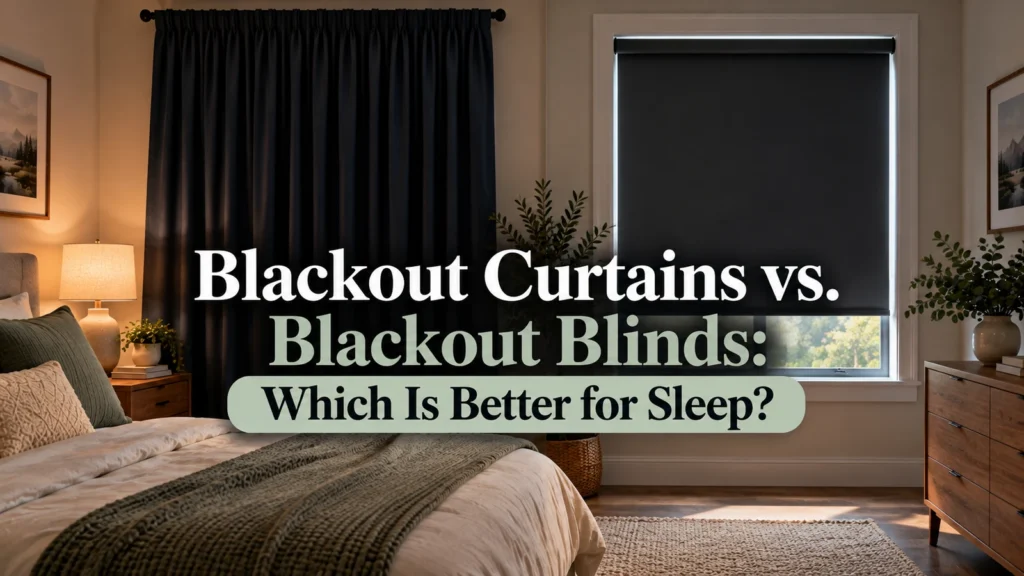
Blackout curtains and blackout blinds can both make a bedroom substantially darker, but neither is automatically better for sleep. The better choice is the one that controls light at your particular window-including the edges-while fitting your room, budget, rental restrictions, and daytime needs.
For many bedrooms, curtains are the simpler, more forgiving option because wide panels can extend beyond the window frame and cover side gaps. A well-fitted blackout blind can look cleaner and take up less space, but an inside-mounted blind may leave narrow light gaps unless the system is designed with side channels or additional coverage. If maximum darkness matters, especially for daytime sleep, layering a blackout blind or shade with curtains can be more effective than treating the decision as either/or.
The sleep reason for controlling light is straightforward: NHLBI recommends keeping the bedroom quiet, cool, and dark, and specifically suggests light-blocking curtains for shift workers sleeping during the day. The comparison below focuses on practical light control rather than claiming that one window treatment will cure a sleep problem.
1. Quick Comparison: Blackout Curtains vs. Blackout Blinds
| Factor | Blackout Curtains | Blackout Blinds / Shades |
| Edge-light control | Good when panels extend well beyond the frame; wraparound rods can improve side coverage. | Depends heavily on mount and design; inside mounts may show side gaps, while side-channel systems can improve coverage. |
| Installation | Usually straightforward but requires enough wall space and secure rod hardware. | Can be compact and precise; measurements matter more, especially for inside mounts. |
| Rental friendliness | Often easier to change or remove; no-drill options exist for lighter setups. | No-drill products exist, but fitted blackout systems may require mounting hardware. |
| Daytime appearance | Adds fabric, softness, and visual weight to the room. | Cleaner, more minimal window profile. |
| Cleaning | Fabric may collect dust and may require washing, vacuuming, or dry cleaning depending on material. | Harder/smoother surfaces are often easier to wipe, though mechanisms and fabric shades still need care. |
| Very bright/daytime sleep | Can work well with generous overlap and careful mounting. | Can work well when opaque material is paired with strong edge control; layering may be best for difficult windows. |
| Best fit | People who want forgiving coverage, décor flexibility, or an easier retrofit. | People who want a compact, tailored look and are willing to measure/install carefully. |
2. What Actually Makes a Window Treatment ‘Better for Sleep’?
The label on the package matters less than the darkness you achieve at the pillow. Opaque fabric can stop light from passing through the material, yet the room can still be bright because light travels around the covering. That is why installation geometry is central to this comparison.
Evaluate four things: how opaque the material is, how much of the window opening it covers, how much light escapes around the perimeter, and whether you can use the treatment consistently. A beautiful blind that leaves a bright strip beside the bed may perform worse for your situation than inexpensive curtains mounted wider than the frame.
This also explains why product claims should be interpreted carefully. ‘Blackout’ does not guarantee a pitch-black room after installation. Window dimensions, mounting style, hardware, wall clearance, and adjacent light sources all affect the result.
3. Where Blackout Curtains Have an Advantage
Curtains are flexible because they are not confined to the exact dimensions of the glass. You can mount a rod above the frame, extend it beyond both sides, use panels wider than the opening, and allow the fabric to reach below the window. This extra coverage can hide gaps that would otherwise glow at sunrise.
3.1 Curtains are forgiving on imperfect windows
Older homes, deep trim, unusual frames, and slightly uneven openings can make fitted window treatments more complicated. Curtains can often cover the entire problem area rather than conforming to it. A wraparound rod can bring the outer edges closer to the wall, and overlapping panels can reduce light through the center.
3.2 Curtains can be easier to adapt
If the first installation still leaks light, you can often adjust rod height, panel width, overlap, or side returns without replacing the whole system. They also offer more freedom to change the room’s appearance later.
3.3 The trade-offs
Curtains take up visual and physical space. Heavy panels need suitable hardware, may collect dust, and can interfere with furniture or radiators if the layout is tight. Poorly sized curtains can also leak plenty of light, so ‘curtain’ is not synonymous with ‘dark room.’
4. Where Blackout Blinds Have an Advantage
Blackout blinds or shades can be appealing when you want a compact, streamlined window treatment. Roller and cellular-style blackout shades can sit close to the window and avoid the floor space and fabric volume of curtains.
4.1 Blinds work well in tight rooms
If a desk, dresser, or bed sits close to the window, a blind can preserve usable space. It can also be easier to raise fully during the day, which is useful when you want daylight without moving large fabric panels.
4.2 Precise systems can control light very well
The important word is system. An opaque roller alone may leave narrow gaps at its sides, particularly when mounted inside the frame. Products designed with cassettes, side channels, or outside-mount coverage can address those gaps more effectively. The result depends on the specific installation rather than on the word ‘blind.’
4.3 The trade-offs
Measurements are less forgiving. A blind that is slightly too narrow can create a persistent strip of light, while an inside mount is limited by the window recess. Custom or side-channel systems may also cost more than basic curtain panels.
5. Which Blocks More Light?
There is no reliable category-wide answer. A properly installed curtain system can outperform a poorly fitted blind, and a well-designed blackout blind with effective side channels can outperform curtains that leave gaps. Compare the complete installation, not just the material.
If you need very strong darkness, test where light enters. Curtains often make it easier to cover beyond the window perimeter. Blinds can control the glass area neatly but may need an outside mount, side channels, or a second layer to manage edge light.
For difficult bedrooms, the strongest practical solution may be a layered setup: an opaque blind or shade close to the window plus wide blackout curtains over it. That is particularly relevant to night-shift workers or rooms facing intense morning sun.
6. Which Is Better for Renters?
Curtains often have an advantage for renters because they can be easier to replace, reposition, and take to the next home. However, heavy blackout curtains still need safe support, and drilling may be restricted by a lease.
No-drill blinds and tension-mounted solutions can also work, but their suitability depends on the window dimensions and product weight. Before using adhesive products, check whether removal could damage paint or trim. A temporary blackout panel or eye mask may be a better short-term solution than installing an expensive custom system in a temporary home.
7. Which Is Better for Night-Shift Workers?
For someone sleeping in daylight, maximum edge control matters more than aesthetics. NHLBI specifically advises shift workers to remove light distractions during daytime sleep and gives light-blocking curtains as an example.
Choose whichever setup produces the darker room at your window. If daylight remains visible around a blind, add side control or curtains. If curtains glow around the perimeter, improve their mounting or add a shade behind them. Daytime sleepers have a stronger reason to consider layering because daylight exposes installation gaps that may be barely noticeable at night.
8. Which Is Better for Small Bedrooms?
A blind is often easier to integrate into a small bedroom because it stays close to the window and does not require wide panels beside it. That can matter when the bed or storage furniture sits close to the wall.
But do not sacrifice the actual purpose. If an inside-mounted blind leaves strong side light directly beside your pillow, compactness is not a meaningful advantage. An outside-mounted shade or carefully fitted curtain may still be the better use of space.
9. Cost: Compare the Whole Setup
Avoid comparing only the sticker price of one curtain panel with one blind. Curtains may require two panels, a rod, brackets, anchors, and possibly side-return hardware. Blinds may require custom sizing, mounting hardware, a cassette, or side channels.
Measure first and price the complete installation. If your existing blinds already provide privacy, adding blackout curtains may be cheaper than replacing the blinds. Conversely, if you already have decorative curtains you like, adding an opaque shade behind them may be the more efficient upgrade.
10. When Combining Curtains and Blinds Makes More Sense
The comparison does not need a single winner. Layering can solve different parts of the same problem: the blind handles the glass area and everyday light control, while curtains extend beyond the frame and reduce perimeter leakage:
- Daytime sleepers dealing with strong sunlight.
- Bedrooms facing streetlights or illuminated signs.
- Windows where an inside-mounted blind leaves obvious side gaps.
- Rooms where you want a minimal blind during the day but softer fabric décor at night.
- Existing window treatments that work well except for one remaining source of light.
Before layering, make sure the window can still open safely and that the treatments do not obstruct heaters, vents, or other equipment.
11. A Simple Decision Checklist
- Choose curtains first if you want broad, forgiving coverage beyond the window frame.
- Consider blinds first if space is tight and you prefer a clean, compact treatment.
- Prioritize edge control if you are highly sensitive to morning or street light.
- For daytime sleep, judge the setup in full daylight-not at night.
- If you already own one treatment, consider improving or layering it before replacing everything.
- Measure the window, trim, wall clearance, and furniture position before buying.
- Check rental rules before drilling or using strong adhesives.
- Remember that a darker bedroom supports the sleep environment but does not treat persistent sleep disorders.
12. Frequently Asked Questions
12.1 Are blackout curtains better than blackout blinds for sleep?
Not universally. Curtains can be easier to extend beyond the window and hide edge gaps, while well-fitted blackout blinds can provide excellent light control in a compact format. Installation quality is usually more important than the category.
12.2 Do blackout blinds block all light?
Opaque blind material can block light through the fabric, but light may still enter around the sides, top, or bottom. Side channels, outside mounting, or layering can improve perimeter control.
12.3 Are blackout curtains enough for daytime sleep?
They can be, especially when they extend beyond the frame and control edge leakage. In very bright rooms, combining curtains with an opaque shade or blind may create a darker result.
12.4 Which option is easier for renters?
Curtains are often easier to adapt and take with you, but heavy panels still require secure support. No-drill blinds and temporary blackout solutions are alternatives when leases restrict permanent mounting.
12.5 Should I use curtains and blinds together?
If one treatment leaves noticeable light gaps, layering can be practical. It can also give you flexible daytime light control while preserving stronger darkness for sleep.
12.6 What should I buy first?
Inspect your current window at the time you sleep. If the existing treatment blocks the glass but leaks around the edges, improve coverage rather than automatically replacing it. Buy the solution that addresses the actual leak.
13. Final Takeaway
For sleep, the better choice is not ‘curtains’ or ‘blinds’ in the abstract. It is the window treatment that gives your bedroom the darkness you need with the fewest troublesome gaps.
Curtains are generally more forgiving when you need coverage beyond the frame; blinds are generally more compact and visually streamlined. For demanding light conditions, especially daytime sleep, combining the two can be the most practical answer.
Read more: How to Make Your Bedroom Darker for Better Sleep
Related guide: How to Create a Sleep-Friendly Bedroom: A Practical Guide
Sources
- CDC — About Sleep
- NHLBI — Healthy Sleep Habits
- Sleep Foundation — How to Make Your Bedroom Dark for Better Sleep
