
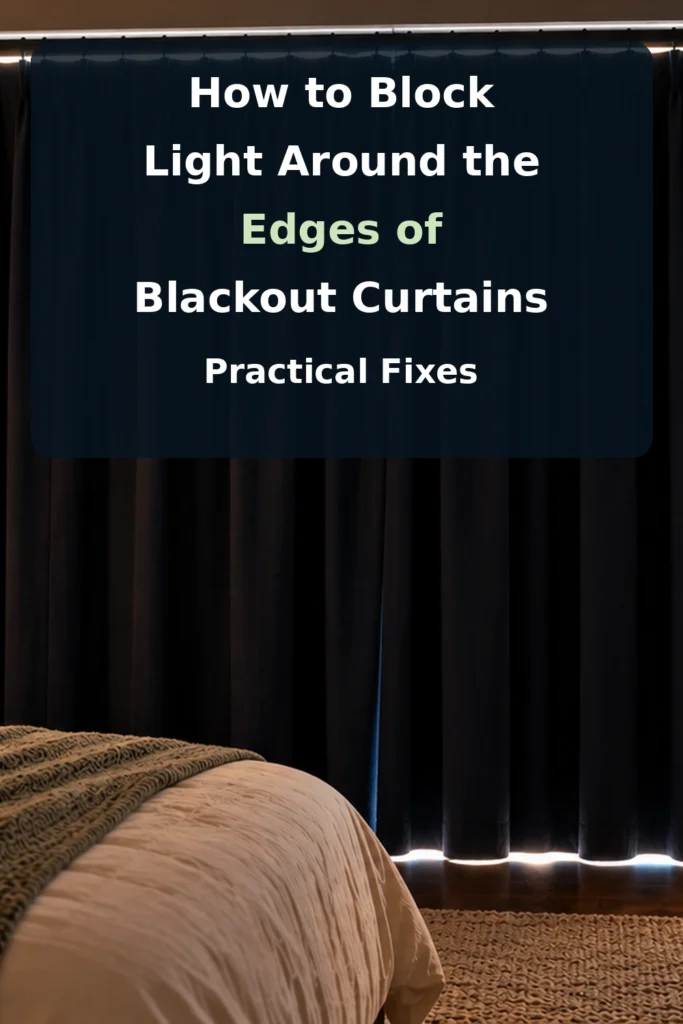
If your blackout curtains are dark in the middle but bright around the top, sides, or bottom, the fabric is probably not the main problem. The fix is to reduce the path light takes around the curtain: extend coverage beyond the window, bring the curtain closer to the wall, overlap the center, and deal with the top and bottom gaps that remain.
CDC/NIOSH sleep-environment guidance specifically recommends making the bedroom very dark and making adjustments to block light entering around the edges of window coverings. That makes edge control especially useful for bedrooms exposed to streetlights, early sunrise, or full daylight when a night-shift worker is trying to sleep.
You do not necessarily need new curtains. In many rooms, changing the rod position or adding a small, reversible light-blocking measure works better than replacing perfectly opaque panels.
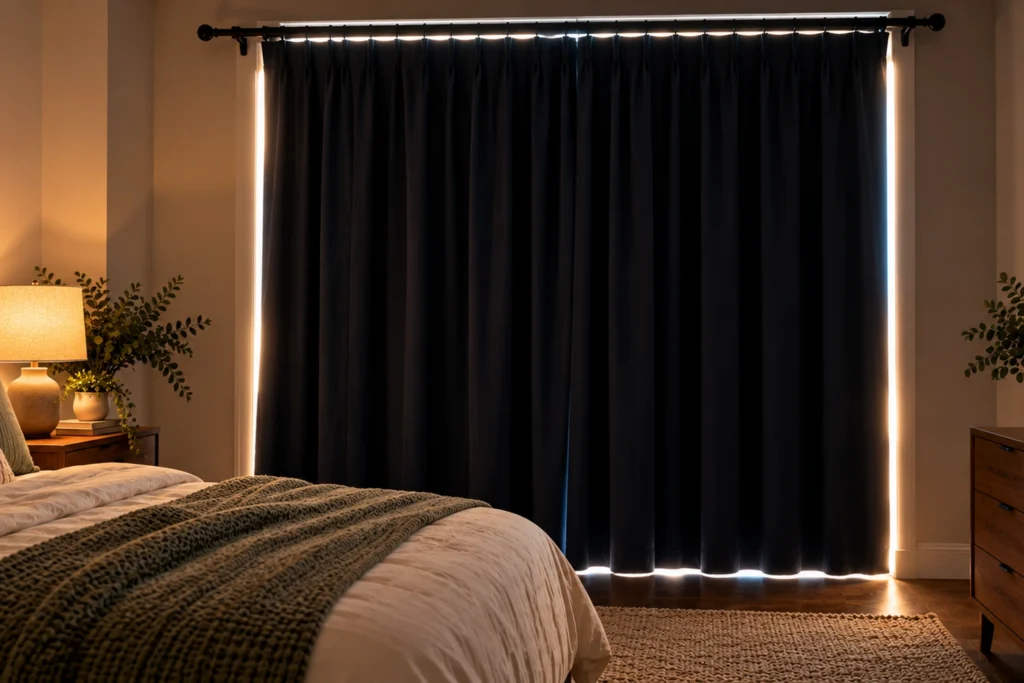
1. Identify Which Curtain Edge Is Leaking Light
Check the room under the lighting conditions that actually bother you. If morning sun wakes you, inspect the curtains after sunrise. If a streetlight is the problem, check them at night. Turn off indoor lights and look from the pillow rather than standing directly beside the window.
- Top gap: a bright band appears between the curtain heading and the wall or ceiling.
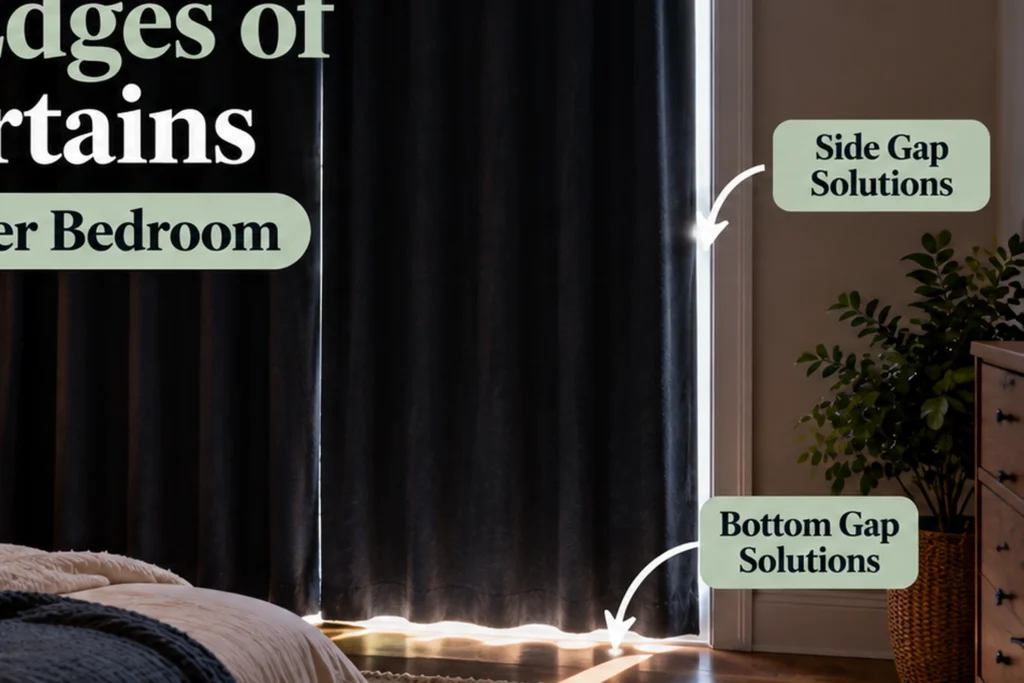
- Side gaps: vertical strips of light appear between the curtain edges and the wall or window trim.
- Center gap: light appears where two panels meet.
- Bottom gap: light escapes beneath curtains that end above the sill or floor.
Through-fabric glow: the curtain itself brightens rather than only its edges; this points to fabric opacity rather than installation.
Treat the gap you can see. A side-gap solution will not fix a curtain that glows across its entire surface, and buying heavier fabric will not automatically fix a large opening above the rod.
2. Fix Side Gaps by Extending Curtains Beyond the Window
Side gaps are common because curtain rods are often only slightly wider than the window frame. When the panels close, the fabric ends close to the glass and light travels around the outside edge.
If wall space allows, extending the rod farther beyond the window can move the curtain edge away from the illuminated opening. Wider panels are also useful because the fabric needs enough fullness to cover the window and still reach the wall-side return.
2.1 Consider a wraparound curtain rod
A wraparound or return-style rod curves or extends toward the wall at each end. This allows the outer curtain edge to sit closer to the wall instead of hanging several inches in front of it. It can be one of the cleaner ways to reduce a vertical strip of light without attaching the fabric directly to the wall.
2.2 Create a removable side return
If you already own a standard rod, you may be able to guide the outer edge of the curtain toward the wall using appropriate removable fasteners, magnetic solutions, or a discreet hook. Choose a method compatible with your curtain and wall surface, and avoid adhesives that may damage paint.
For renters, test any adhesive in an inconspicuous location and follow the lease rules. A reversible solution is more useful than a perfectly dark room that leaves damaged walls at move-out.
3. Reduce the Top Gap
Light above the curtains is often caused by a rod mounted too low or too far from the wall. The brighter the exterior light, the more noticeable that horizontal gap can become.
If you can remount the hardware, raising the rod so the curtain starts above the window frame can reduce the direct line of light. Bringing the rod closer to the wall can also help, provided the curtain still moves freely and clears the trim.
3.1 Use a valance, cornice, or top light blocker when needed
A valance or cornice can cover the space above the curtain and intercept light that otherwise spills over the top. This is more involved than repositioning a rod, but it can be useful when the window is exposed to intense daylight and the upper gap remains obvious.
Temporary top blockers can also work, but they should be stable and should not interfere with curtain hardware, ventilation, sprinklers, heaters, or other safety equipment.
4. Stop Light Through the Center Gap
Two blackout panels can each be fully opaque and still create a bright vertical seam where they meet. The simplest fix is usually more overlap.
Close the curtains and pull one panel slightly past the centerline of the other. If there is not enough fabric to overlap without exposing the sides, the panels may be too narrow for the window and rod width.
Curtain clips, discreet magnets, or other removable closures can help keep the center together, especially when air movement repeatedly separates the panels. Make sure any added hardware does not create sharp points near the bed or damage the fabric.
5. Deal With the Bottom Gap
If curtains stop well above the floor or window sill, daylight can reflect into the room from below. Longer panels can reduce this path. For floor-length curtains, allowing the fabric to reach the floor-or come very close without becoming a trip hazard-can reduce visible light beneath the treatment.
For a window above furniture, a second opaque shade close to the glass may be more practical than very long curtains. The objective is not to make every curtain touch the floor; it is to interrupt the light path that is actually visible from the bed.
6. Add a Second Layer When Edge Fixes Are Not Enough
A shade or blind mounted closer to the window can reduce the amount of light that ever reaches the curtain layer. The curtain can then handle perimeter leakage and provide the room-facing finish.
This layered approach is especially useful for strong morning sun and daytime sleep. It also explains why the question is sometimes not ‘curtains or blinds?’ but how the two can work together.
Related comparison: Blackout Curtains vs. Blackout Blinds: Which Is Better for Sleep?
7. Renter-Friendly Ways to Reduce Curtain Edge Light
Renters often need to balance darkness with reversibility. Before drilling new holes, see whether the current hardware can be adjusted or whether a removable solution can close the most obvious gap.
- Use a tension-mounted blackout layer inside a suitable window recess.
- Try removable side fasteners that are rated for the wall surface.
- Use an eye mask when permanent window changes are not allowed.
- Add a temporary opaque panel behind existing curtains for daytime sleep.
- Reposition furniture only if it can safely help shield a direct beam without blocking exits, heaters, or ventilation.
Avoid improvised materials that create fire, moisture, or window-damage risks. Follow product instructions, especially where direct sun can heat the window area.
8. What Not to Do
The fastest-looking fix is not always the safest or most durable. Do not permanently seal a window that may be needed for ventilation or emergency egress. Do not place fabric against heaters or other hot equipment. Do not block smoke detectors, sprinklers, vents, or electrical equipment.
Also avoid assuming that ‘more blackout’ is always the answer. If the room is already dark but sleep remains difficult, noise, temperature, comfort, schedule, or another sleep issue may matter more.
9. Best Fix by Type of Light Leak
| Light leak | Try first | If it still leaks |
| Top | Raise the rod and/or reduce distance from wall | Add a valance, cornice, or second window layer |
| Sides | Extend rod beyond frame; use wider panels | Wraparound rod or removable side returns |
| Center | Increase panel overlap | Use discreet clips/magnets or wider panels |
| Bottom | Use longer panels where appropriate | Add an opaque shade closer to the window |
| Whole fabric glows | Confirm curtain opacity | Add blackout lining or replace with truly opaque material |
10. A Five-Minute Test Before You Buy Anything
Before ordering new curtains or hardware, temporarily cover the problem gap for one sleep period. For example, hold the side edge closer to the wall with a safe removable method or temporarily block the top gap. If the room becomes meaningfully darker, you have confirmed where the investment should go.
This test also prevents a common mistake: replacing blackout curtains because the room is bright when the real problem is the installation around them.
11. Frequently Asked Questions
11.1 Why is light coming around my blackout curtains?
Usually because the curtains block light through the fabric but do not fully cover the window perimeter. Common causes are a rod that is too narrow or low, panels that are too short or narrow, distance between the fabric and wall, or a center seam that does not overlap.
11.2 How do I block light from the sides of blackout curtains?
Extend the curtain coverage beyond the window frame and bring the outer panel edges closer to the wall. A wider rod, wider panels, a wraparound rod, or a removable side-return method can help.
11.3 How do I stop light coming over the top of curtains?
Mounting the rod higher and closer to the wall can reduce the top opening. For difficult daylight conditions, a valance, cornice, or second opaque layer closer to the window can intercept remaining light.
11.4 Should blackout curtains touch the floor?
They do not have to, but a large bottom gap can allow light into the room. Floor-length panels may reduce that gap when appropriate, provided they do not create a trip hazard or interfere with heating or ventilation.
11.5 Can I fix curtain light gaps without drilling?
Often yes. Depending on the window, tension-mounted layers, removable fasteners, temporary blackout panels, or an eye mask can help. Check surface compatibility and rental rules before using adhesives.
11.6 Is a small amount of edge light a problem?
The practical question is whether the light is noticeable or disruptive for you. U.S. sleep guidance recommends a dark bedroom, but you do not need to pursue a perfectly sealed room if your current environment already works well for your sleep.
12. Final Takeaway
When blackout curtains leak light around the edges, fix the geometry before replacing the fabric. Extend coverage beyond the window, reduce the distance between the curtain and wall, overlap the center, and address the top or bottom gap that is actually visible.
For especially bright windows or daytime sleep, combine curtains with an opaque shade or blind. The most useful setup is the one that controls your real light leak safely, reversibly when needed, and without unnecessary purchases.
Read first: How to Make Your Bedroom Darker for Better Sleep
Bedroom hub guide: How to Create a Sleep-Friendly Bedroom: A Practical Guide
Sources
CDC/NIOSH — Create a Good Sleep Environment
