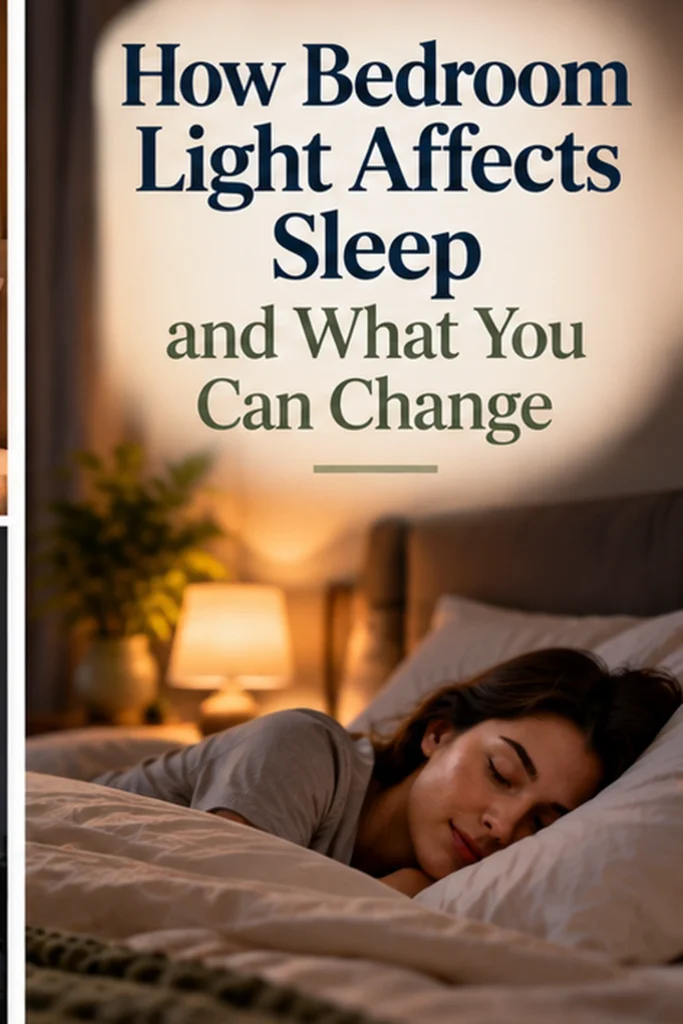

Bedroom light affects sleep because light is one of the strongest environmental signals for your body clock. Bright light at the wrong time can promote alertness and shift sleep timing, while darkness supports the biological conditions associated with sleep. The practical goal is not to make your home dark all day. It is to get useful light when you want to be awake and reduce unwanted light as bedtime approaches and while you sleep.
For most people, the highest-value changes are simple: get daylight during the day, dim unnecessary bright light before bed, remove or cover glowing bedroom electronics, and control outdoor light that reaches the bed. If you need a nightlight for safety, a dim warm-colored light is generally a more sleep-friendly choice than a bright white or blue light.
1. Why Light Has Such a Strong Effect on Sleep
Your sleep-wake cycle is coordinated partly by a central circadian clock in the brain. Light entering the eyes provides timing information to this system. NHLBI explains that the natural light-dark cycle helps keep the central body clock synchronized, and that artificial light can interfere with this process.
Melatonin is one part of this system. Its level normally rises in the evening and is associated with the biological night. Bright artificial light late in the evening can interfere with melatonin release and make it harder to fall asleep. This does not mean that every lamp or screen will ruin sleep; intensity, timing, duration, spectrum, distance, and individual sensitivity all matter.
CDC/NIOSH guidance similarly describes light as a signal for wakefulness and darkness as a signal for sleep. The circadian system is particularly sensitive to light around the usual sleep period, which is why lighting choices near bedtime can matter more than the same light in the middle of the day.
2. Daytime Light Is Not the Enemy
A common mistake is to interpret sleep advice as a reason to avoid bright light in general. Daytime light serves a different purpose. Exposure to daylight, especially earlier in your waking day, helps provide a strong daytime signal to the circadian system and can support alertness.
NIOSH recommends spending time outside in daylight and notes that bright light in the first hours of the day can be particularly helpful. NHLBI likewise recommends spending time outside when possible. The useful pattern is contrast: brighter days and darker nights.
If your bedroom doubles as a home office, do not keep it cave-dark all day in the hope that this will improve nighttime sleep. Open the shades after waking, use the room normally during waking hours, and reserve the stronger light reduction for the period when you are preparing to sleep.
3. Evening Light: Reduce Brightness Before Bed
The hours before bedtime are when many people can make an easy improvement. NIOSH advises dimming lights before sleep when falling asleep is difficult, and NHLBI recommends avoiding bright light during the quiet period before bed.
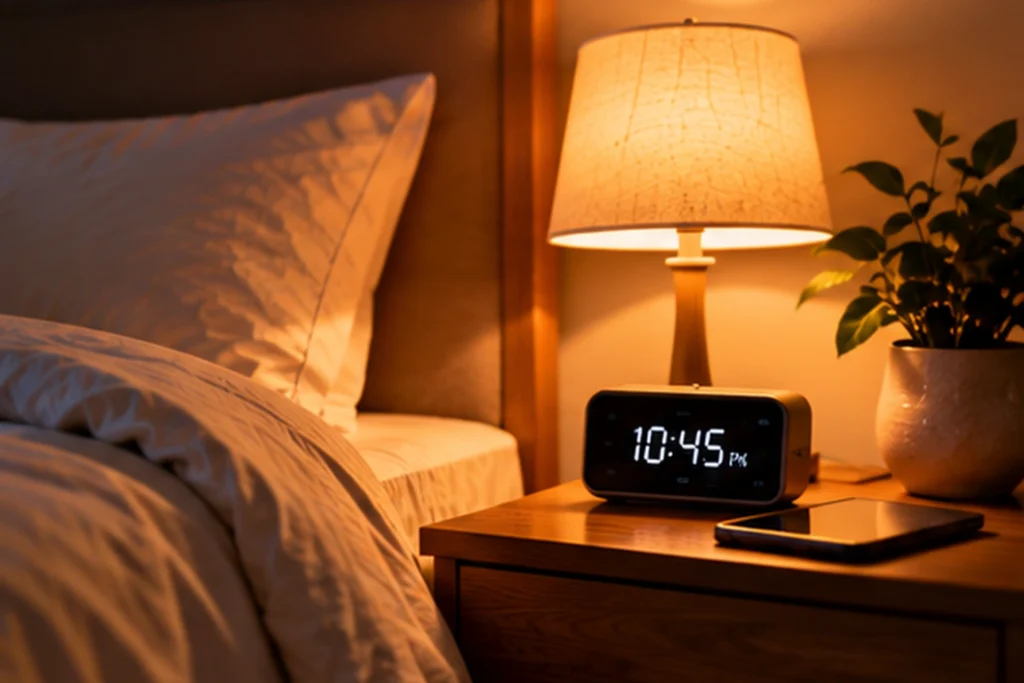
You do not need to sit in complete darkness all evening. Instead, reduce unnecessary intensity. A bright ceiling fixture can often be replaced by a lower-output bedside or floor lamp. Position light where you need it rather than flooding the whole room. If you read before bed, use enough light to read comfortably without turning the entire bedroom into a brightly lit workspace.
Warm-colored light is often a practical choice for evening ambience, but brightness still matters. A very bright warm lamp is not automatically harmless simply because its color looks cozy.
4. Screens Matter, but the Problem Is Broader Than Phones
Phones receive most of the attention, yet bedroom light exposure can come from televisions, tablets, computers, LED indicators, digital clocks, chargers, smart-home devices, hallway light, and outdoor lighting. NHLBI notes that light from electronic devices can disrupt the sleep-wake cycle, while NIOSH recommends blocking or removing white and blue light sources from the bedroom.
If you use a phone near bedtime, reducing brightness, using a warmer display setting, and stopping stimulating activities before sleep may be useful. But do not spend twenty minutes optimizing a screen setting while leaving a bright overhead light on. Think about the whole lighting environment.
5. Light During Sleep: Small Sources Can Be Surprisingly Noticeable
Once you are asleep, the room does not need to be visually perfect, but reducing unnecessary light is a reasonable goal. NHLBI recommends a dark bedroom, and NIOSH describes a very dark sleep environment as helpful for sleep.
Research summarized by NHLBI has also raised concern about ambient light exposure during sleep. These studies do not prove that one nightlight will cause disease, and observational findings should not be interpreted as individual diagnosis. They do reinforce a practical recommendation already present in sleep guidance: avoid unnecessary light during the sleep period.
Start with the obvious sources: a bedside lamp left on, television glow, bright clock display, charging indicators, light entering through curtains, or a hallway light shining beneath the door.
6. Window Light: Fix the Leak, Not Just the Curtain
Outdoor light can come from sunrise, streetlights, neighboring buildings, signs, parking lots, or security lighting. The solution depends on where the light enters.
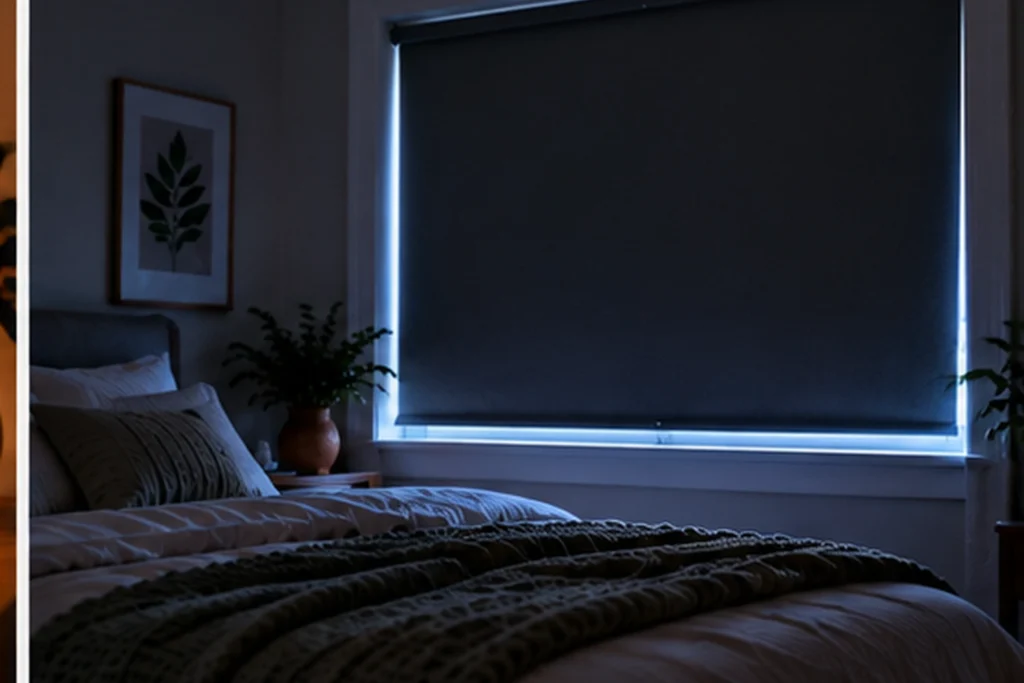
NIOSH specifically recommends opaque window coverings and adjusting them to block light entering around the edges. This matters because a blackout fabric can be highly opaque while the room remains bright through gaps at the top and sides.
Read more: How to Block Light Around the Edges of Blackout Curtains
If curtains are not practical, temporary shades, removable panels, blinds layered with another opaque covering, or a comfortable sleep mask can be alternatives.
Read more: Best Ways to Block Bedroom Light Without Blackout Curtains
7. Daytime Sleep Needs More Aggressive Light Control
People who sleep during the day face a stronger mismatch between the environment and the intended sleep period. Daylight is bright, household activity is higher, and the circadian system may still be promoting wakefulness.
NHLBI recommends removing light distractions during daytime sleep for shift workers, including the use of light-blocking curtains. NIOSH similarly advises making the bedroom very dark for daytime sleep.
This is one situation where layering solutions can make sense: an opaque window covering for room-level darkness plus an eye mask for residual leaks.
Read more: How to Darken a Bedroom for Daytime Sleep
8. Do You Need Blackout Curtains or a Sleep Mask?
Not necessarily. The right tool depends on the source of the light. If the whole bedroom is bright every night, improving the window treatment is a passive solution that works without anything on your face. If you travel, rent, share a bedroom, or only need to block a small amount of light, a sleep mask may be simpler.
The two approaches are not competitors in every situation. Curtains change the room; a mask changes the light reaching your eyes.
Read more: Sleep Mask vs. Blackout Curtains: Which Works Better?
9. What About a Nightlight?
A nightlight can be useful when darkness creates a fall or navigation risk. NIOSH suggests a dim red nightlight for getting to the bathroom, and NHLBI has discussed dim warm-colored nightlights as a safer option for older adults who need visibility.
The goal is to use the least light needed for safe movement. Place it low, keep it dim, and avoid pointing it directly toward the bed. A safety light is different from leaving a bright bedside lamp or television on all night.
10. A Practical Bedroom Light Audit
Stand in your bedroom at the time you normally sleep and look for the actual sources rather than assuming the window is the only problem.
- Window: Is light coming through the fabric, or mainly around the edges?
- Door: Does hallway light enter under or around it?
- Electronics: Which LEDs, displays, chargers, clocks, or screens remain visible?
- Bed position: Does outdoor light fall directly across your face or pillow?
- Pre-bed lighting: Are you using a bright ceiling fixture when a smaller lamp would do?
- Safety: Do you genuinely need a nightlight, and can it be dimmer or positioned lower?
- Morning routine: Are you getting enough useful daylight after waking?
Change one or two high-impact sources first. You do not need to buy a collection of sleep products simply because the room contains light.
11. What to Change First: A Simple Priority Order
| Priority | Change | Why it comes here |
| 1 | Turn off unnecessary bedroom lights and screens | Free and immediate |
| 2 | Cover or dim bright LED displays | Targets light that stays on all night |
| 3 | Use lower, dimmer evening lighting | Reduces pre-bed brightness |
| 4 | Fix window gaps or improve window coverage | Addresses persistent outdoor light |
| 5 | Block hallway light under the door | Useful when the rest of the room is already dark |
| 6 | Try a sleep mask if environmental control is limited | Portable and renter-friendly |
| 7 | Upgrade curtains or shades if the room remains consistently bright | Room-level long-term solution |
12. Avoid Turning Light Control Into Sleep Anxiety
A dark bedroom is a useful environmental target, not a test you have to pass. Sleep guidance does not require measuring every LED or creating laboratory darkness at home. If you are sleeping well, there is little reason to become anxious about a tiny indicator light.
Focus on light that is clearly bright, persistent, directly visible from bed, or associated with difficulty sleeping. If sleep problems continue despite adequate sleep opportunity and reasonable environmental changes, the next step is not necessarily a stronger curtain. Persistent insomnia or excessive daytime sleepiness deserves discussion with a healthcare professional.
13. Frequently Asked Questions
13.1 Does bedroom light really affect sleep?
Yes. Light is a major environmental signal for the circadian system. Bright light near the usual sleep period can promote alertness and alter sleep timing, while major health organizations recommend a dark bedroom for sleep.
13.2 Is complete darkness necessary?
No universal threshold applies to every person. The practical recommendation is to keep the bedroom dark and reduce unnecessary light. A dim nightlight may be appropriate when needed for safety.
13.3 What color light is best before bed?
Dimmer light is the first priority. NIOSH notes that blue and white light have stronger circadian effects than red light. Warm, low-intensity lighting can therefore be a practical evening choice.
13.4 Should I cover every LED in the bedroom?
Cover or turn off LEDs that are bright or distracting. There is no need to become obsessive about a tiny light that does not bother you or meaningfully illuminate the room.
13.5 Is morning sunlight good for sleep?
Daytime light, particularly earlier in the waking day, helps reinforce the daytime signal to the circadian system. Sleep guidance encourages spending time outside when possible.
13.6 What if I sleep during the day?
Daytime sleepers often need stronger light control. Light-blocking curtains, opaque shades, edge control, and an eye mask can help create a darker sleep environment.
14. Final Takeaway
Bedroom lighting works best when it follows a simple rhythm: useful light while you are awake, less bright light as bedtime approaches, and a dark environment while you sleep. You do not need to redesign the room all at once.
Begin with the largest source of unwanted light. Dim the evening environment, remove glowing electronics that are easy to fix, improve window coverage where needed, and preserve safe low-level lighting if you must get up at night. The best bedroom lighting strategy is the one that supports sleep without making your routine complicated.
External Sources Used
NHLBI – How Sleep Works: Your Sleep/Wake Cycle
CDC/NIOSH – Effects of Light on Circadian Rhythms
CDC/NIOSH – Create a Good Sleep Environment
CDC/NIOSH – Improve Sleep: Tips to Improve Your Sleep When Times Are Tough