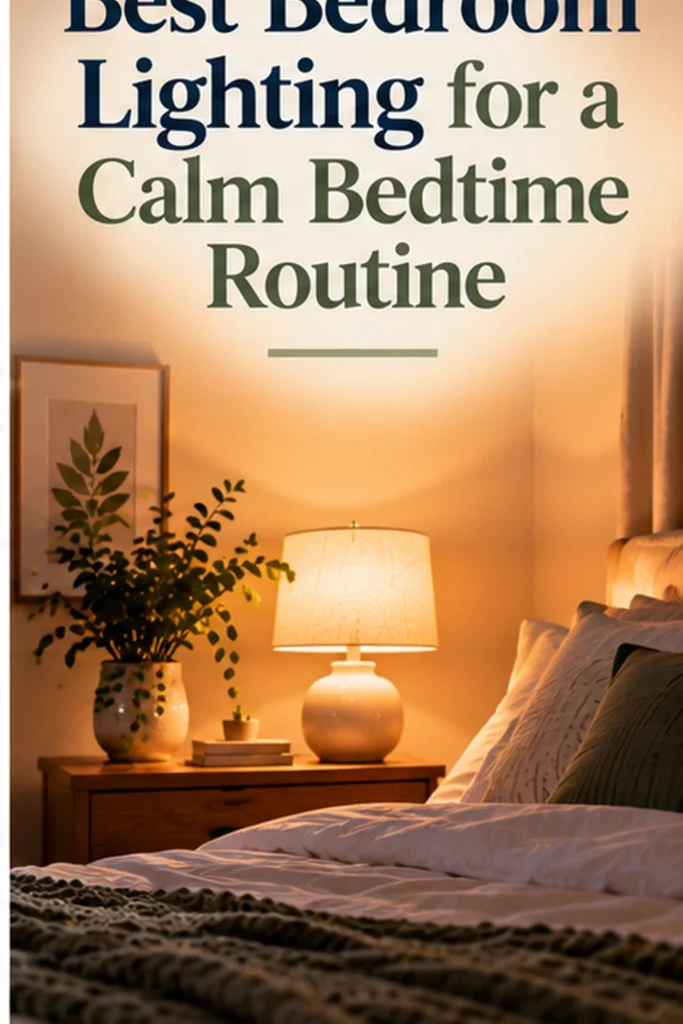

The best bedroom lighting for a calm bedtime routine is not a single bulb, lamp, or color temperature. It is a gradual change in the room: brighter light while you are active, then lower and softer light as bedtime approaches, followed by darkness during sleep. For most bedrooms, that means relying less on a bright ceiling fixture at night and more on one or two dim, warm-looking lamps placed where you actually need them.
This approach is consistent with sleep guidance from NHLBI and CDC/NIOSH. NHLBI recommends avoiding bright artificial light during the quiet hour before bed and keeping the bedroom dark for sleep. NIOSH explains that the circadian system is sensitive to evening light and advises dimming lights before bedtime when falling asleep is difficult.
You do not need expensive smart lighting to create this effect. A well-placed bedside lamp, a dimmer or lower-output bulb, and a simple habit of switching off bright overhead lights can change the feel of the room more than adding decorative fixtures.
1. Think in Layers, Not One Perfect Bedroom Light
A bedroom has several lighting jobs. You may need enough light to get dressed, clean, find something in a drawer, read, move safely at night, and relax before sleep. One fixture rarely does all of these jobs well.
A practical bedroom usually benefits from three layers:
- General light for daytime tasks and cleaning.
- Low, localized evening light for winding down, reading, or preparing for bed.
- Very dim safety light only when needed after lights-out.
The mistake is using the first layer for every activity. A bright overhead fixture is useful when you are putting away laundry, but it may be unnecessarily intense while you are sitting in bed twenty minutes before sleep.
2. The Most Important Change: Dim the Room Before Bed
If you change only one thing, reduce the amount of bright light in the period before sleep. NHLBI recommends using the hour before bed for quiet time and avoiding bright artificial light. NIOSH guidance notes that avoiding bright light around two hours before usual bedtime can make it easier to fall asleep for people on a regular nighttime sleep schedule.
This does not require sitting in darkness. The goal is a clear visual transition from active evening to bedtime.
- Turn off the main ceiling light when your wind-down routine begins.
- Use a bedside or floor lamp instead of lighting the entire room.
- Dim the lamp if possible rather than relying on maximum brightness.
- Keep the light source out of your direct line of sight when lying in bed.
3. Warm Light Works Best as Part of a Dim-Lighting Strategy
Warm-looking light-often described as amber, soft white, or warm white-fits a bedtime routine because it feels less like daylight and can create a calmer visual environment. But color alone should not become the entire strategy.
Light intensity and timing matter. A very bright warm lamp can still be stimulating, while a dimmer source used for a quiet activity may be more appropriate. NIOSH notes that blue and white light have stronger circadian effects than red light, but the broader recommendation remains straightforward: reduce bright evening light.
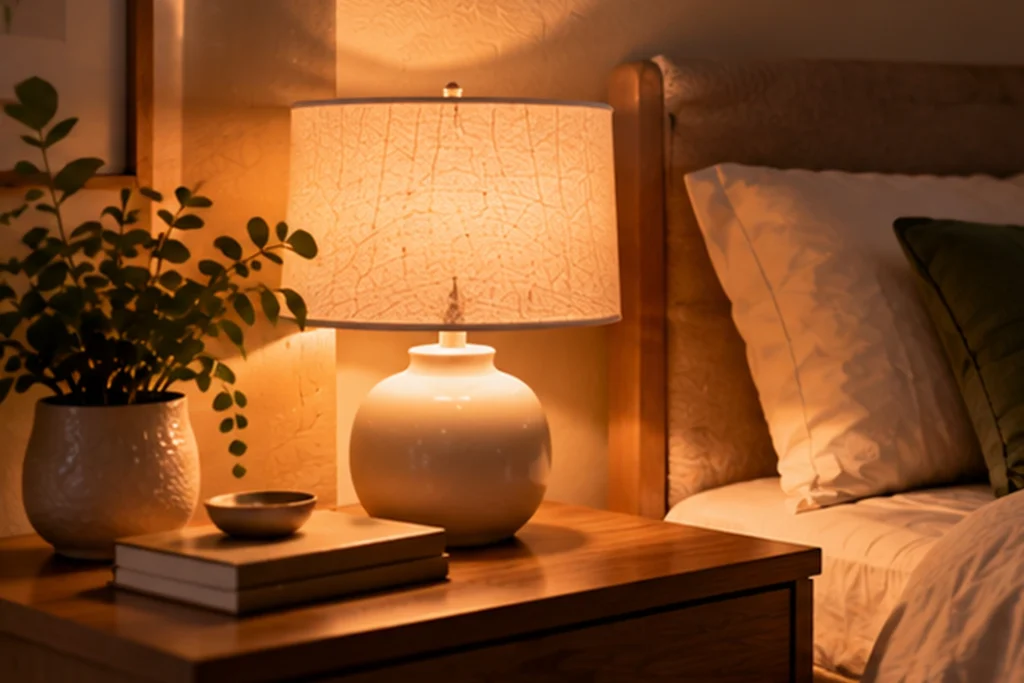
For ordinary home lighting, you do not need to chase an exact scientific color number. If you are buying bulbs, a warm-white option in the roughly 2200K-3000K range is a practical design choice for evening lamps. Treat that as a comfort-oriented lighting range rather than a medical threshold.
4. Where to Put a Bedside Lamp
Placement can matter as much as the bulb. A lamp positioned close to where you read or prepare for sleep can provide useful illumination at a lower overall brightness than a ceiling fixture.
For a bedside table, aim for light that reaches the book, nightstand, or immediate area without shining directly into your eyes. A shade that diffuses the bulb can reduce glare. If two people share the room, separate bedside lamps allow one person to use localized light without flooding the entire bedroom.
Wall-mounted reading lights can also work well, but renters may prefer table lamps or plug-in fixtures that do not require drilling.
5. Reading in Bed: Enough Light to Read, Not Enough to Light the Room
A calm bedtime routine often includes reading. The practical goal is not to read in near-darkness. Straining to see text is not a useful sleep strategy. Instead, use a localized lamp bright enough for comfortable reading while keeping the rest of the bedroom relatively dim.

A shaded bedside lamp, directional reading light, or dimmable wall light can work. Position it so the page is illuminated but the bulb itself is not glaring into your eyes.
If your reading happens on a tablet or phone, remember that the device is both a light source and an interactive tool. Lowering brightness and using a warmer display setting may reduce the visual intensity, but putting the device down remains the simplest way to remove its light from the bedtime environment.
6. What About Blue Light?
Blue light is real, but bedroom lighting decisions should not become a hunt for one villainous wavelength. The circadian system is particularly responsive to shorter-wavelength blue-green light, and bright screens or cool-white lighting at night can contribute to evening light exposure.
However, all visible light has the potential to affect the circadian system depending on brightness, timing, duration, and individual sensitivity. That is why the most practical order is: reduce unnecessary brightness first, use warmer light where convenient, and avoid staring at bright screens close to bedtime.
Harvard Health has also cautioned that commercial blue-light-blocking glasses are not standardized, so buying specialized glasses is not a substitute for sensible evening light habits.
7. Keep Bright Overhead Lighting for the Earlier Evening
There is nothing inherently wrong with a ceiling light. The issue is timing and purpose. Use bright general lighting when you need to clean, organize, pack, or get ready. Then change the room when the active part of the evening is over.
This transition can become part of the bedtime routine itself. Switching off the overhead light and turning on the bedside lamp is a simple environmental cue that the day is winding down.
Read more: How Bedroom Light Affects Sleep and What You Can Change
8. A Simple 60-Minute Bedroom Lighting Routine
| When | Lighting move | Practical setup |
| 60–45 minutes before bed | Turn off bright overhead lighting | Use one or two lower, warmer lamps |
| 45–20 minutes | Quiet activities | Keep light localized to reading, showering, or preparing clothes |
| 20–0 minutes | Reduce unnecessary screens and room light | Use the minimum comfortable light |
| Lights-out | Make the bedroom dark | Turn off lamps and cover distracting LEDs |
| If you wake at night | Use only enough light for safety | Choose a very dim, low-positioned warm/red light if needed |
The exact timing is flexible. You are building a repeatable transition, not following a minute-by-minute medical protocol.
9. Nightlights: Safety Comes First
Complete darkness is not appropriate if it makes nighttime movement unsafe. NHLBI notes that a dim nightlight is fine when needed, and NIOSH recommends a dim red nightlight when getting up during the night.
Place the nightlight low-near the floor or along the route to the bathroom-rather than at eye level beside the bed. Use the minimum brightness that lets you navigate safely. A motion-activated low-level light can also prevent the room from staying illuminated all night.
10. Do Smart Bulbs Help?
Smart bulbs are convenient, not essential. Their biggest advantage is automation: they can gradually dim, shift to a warmer appearance, or turn off on a schedule. This can make a consistent routine easier if you otherwise forget to change the lighting.
But a basic lamp with a warm bulb and an inexpensive dimmer can accomplish the central goal. Do not assume that an app-controlled bulb is automatically more sleep-friendly if it remains bright late into the evening.
11. What to Do About LEDs and Digital Displays
After the main lights go off, tiny sources can become visually prominent. Alarm clocks, chargers, air purifiers, televisions, routers, speakers, and power strips may all add light.
- Dim displays when the device offers a night mode.
- Turn the display away from the bed when practical.
- Cover an unnecessary indicator with an appropriate removable light-blocking sticker.
- Do not cover ventilation openings, sensors, or warning indicators that are needed for safe operation.
If the LED is barely visible and does not bother you, there is no reason to become obsessive. The goal is a comfortable dark sleep environment, not a perfectly measurable blackout chamber.
12. Pair Good Evening Lighting With Good Window Control
A carefully dimmed bedroom will still feel bright if a streetlight or neighboring building shines through the window. Indoor and outdoor light control work together.
If the problem is the window, address the window rather than buying another lamp. Blackout curtains, blackout blinds, removable shades, or an eye mask may be more relevant.
Read more: Sleep Mask vs. Blackout Curtains: Which Works Better?
Read more: Blackout Curtains vs. Blackout Blinds: Which Is Better for Sleep?
13. Bedroom Lighting Mistakes That Are Easy to Fix
- Using the brightest ceiling light until the moment you get into bed.
- Buying a warm-colored bulb but running it at unnecessarily high brightness.
- Placing an exposed bulb directly in your line of sight.
- Using decorative string lights or LEDs all night because they look relaxing.
- Keeping a television on as background light while trying to fall asleep.
- Making the room so dark during waking hours that you miss useful daytime light.
- Buying specialized sleep lighting before fixing obvious sources such as a bright lamp or window leak.
The simplest rule is to match light to the activity. Bright enough when you need to see and work; progressively dimmer when the purpose shifts toward relaxation; dark when it is time to sleep.
14. A Bedroom Lighting Shopping Checklist
If you are actually replacing or adding a fixture, focus on function rather than marketing claims.
- A dimmable lamp or fixture, if your electrical setup supports it.
- A warm-looking bulb for evening use.
- A shade or diffuser that reduces direct glare.
- A switch that is easy to reach from the bed.
- Enough localized light for reading without illuminating the whole room.
- A low, dim nightlight only if nighttime safety requires one.
- Simple controls you will actually use every night.
Avoid assuming that labels such as sleep lamp, circadian lamp, or wellness light automatically mean the product has proven sleep benefits. Evaluate the basic lighting behavior first: brightness, placement, timing, glare, and ease of dimming.
15. Frequently Asked Questions
15.1 What is the best bedroom light color before sleep?
A warm-looking, dim light is a practical choice for a bedtime routine. Brightness and timing matter as well as color, so avoid treating color temperature as the only factor.
15.2 Is 2700K good for a bedroom?
Around 2700K is a common warm-white choice and can work well for bedroom lamps. It is a design recommendation rather than a medical cutoff. Lower brightness in the evening is still important.
15.3 Should I use red light before bed?
Dim red light has relatively less circadian effect than blue or white light and is commonly suggested for nightlights. You do not need to turn the entire bedroom red to create a calm routine.
15.4 Are warm LED bulbs better for sleep?
Warm LEDs can be useful for evening lighting because they generally contain less short-wavelength output than cooler-looking LEDs, but a bright warm LED can still provide substantial light. Dimness and timing remain important.
15.5 Is it bad to read with a bedside lamp?
No. Reading can be part of a quiet bedtime routine. Use enough localized light to read comfortably while avoiding unnecessarily bright whole-room lighting.
15.6 Should my bedroom be completely dark while sleeping?
Health guidance recommends a dark bedroom, but a dim nightlight is reasonable when needed for safety. Focus on removing unnecessary or disruptive light rather than pursuing perfection.
16. Final Takeaway
The best bedroom lighting for a calm bedtime routine is a pattern, not a product. Use useful light during the active part of the evening, then deliberately make the room softer and dimmer as bedtime approaches.
For most bedrooms, a warm bedside lamp, lower brightness, reduced screen light, and a dark sleep environment are enough. Build the lighting around what you actually do before bed, and make the transition simple enough that it becomes automatic.
External Sources Used
NHLBI – How Sleep Works: Your Sleep/Wake Cycle
CDC/NIOSH – Effects of Light on Circadian Rhythms
CDC/NIOSH – Improve Sleep: Tips to Improve Your Sleep When Times Are Tough
Harvard Health – Can blue light-blocking glasses improve your sleep?